Download Ebook China's Economy: What Everyone Needs to Know®
How can? Do you think that you don't need enough time to opt for shopping book China's Economy: What Everyone Needs To Know® Never mind! Merely sit on your seat. Open your kitchen appliance or computer as well as be on the internet. You can open up or see the web link download that we offered to obtain this China's Economy: What Everyone Needs To Know® By this method, you can get the on the internet publication China's Economy: What Everyone Needs To Know® Reading the publication China's Economy: What Everyone Needs To Know® by online could be really done conveniently by waiting in your computer system as well as kitchen appliance. So, you can continue every single time you have totally free time.
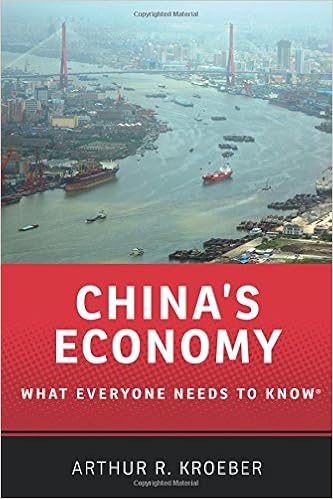
China's Economy: What Everyone Needs to Know®

Download Ebook China's Economy: What Everyone Needs to Know®
Library and also book shop are two essential places to get the books to check out. However, in modern-day age, it will not just evoke the two locations. Lots of sites are currently available for the on-line collection. As below, discovering the numerous publications titles from within and also beyond this country is very easy. You could not only intend to take guide however additionally informal education and learning. As shown, library can be a casual education and learning system to spread out the expertise, from any kind of resources.
Reading a publication is likewise sort of far better remedy when you have no sufficient money or time to get your personal experience. This is among the reasons we reveal the China's Economy: What Everyone Needs To Know® as your buddy in investing the moment. For even more representative collections, this book not only uses it's purposefully book source. It can be a good friend, really good buddy with much understanding.
Yeas, this is good news to know that China's Economy: What Everyone Needs To Know® has actually revealed once more. Lots of people have actually been awaiting this author functions. Even this is not in your much-loved book, it will certainly not be that fault to attempt reading it. Why should be uncertainty to get the brand-new book suggestion? We constantly refer a publication that can be needed for all people. So in this manner, when you should know even more about the China's Economy: What Everyone Needs To Know® that has actually been supplied in this site, you have to sign up with to the link that most of us recommend.
It will certainly lead you to make or end up being someone much better. Valuable times for analysis is obtained since you do not waste the time for something problem. When you really read this publication sensibly as well as perfectly, exactly what you seek fro will certainly be at some point acquired. To obtain China's Economy: What Everyone Needs To Know® in this short article, you should obtain the link. That is the link of guide to download. When the soft file of guide can help you much easier, why not you make a possibility to obtain this publication now? Be the initial people that get this publication right here!
Product details
Series: What Everyone Needs To Know®
Paperback: 336 pages
Publisher: Oxford University Press; 1 edition (April 1, 2016)
Language: English
ISBN-10: 0190239034
ISBN-13: 978-0190239039
Product Dimensions:
8.2 x 1 x 5.5 inches
Shipping Weight: 1.1 pounds (View shipping rates and policies)
Average Customer Review:
4.7 out of 5 stars
62 customer reviews
Amazon Best Sellers Rank:
#21,451 in Books (See Top 100 in Books)
The Chinese economy is consistently a topic that dominates political and economic discussions. The nature of the Chinese economy is often misunderstood and aspects of it can be grossly overstated while others underrepresented. China's Economy discusses many aspects of the largest global economy in purchasing power, exploring the drivers of growth and the political economy that has defined the last 30 years for the country. One gets a sense of the history as well as the challenges it faces for the future. Avoiding sensationalist content the book gives very good balanced perspectives on the critical issues that are often quoted in the news including its debt, its corruption levels, its trade policy and its actual economic weight in the global economy.The book is split into 12 chapters covering a host of topics. The author starts with discussing the huge rural to urban transition that started to occur with the reforms during Deng Xiaoping's leadership. One gets a sense of the low base that growth started from as well as the scale of the transition that needed to occur. China remains a relatively rural population for where it is on the income per capita spectrum. The author discusses how china focused on growing its capital base along the coast to drive export led growth, similar to other Asian tiger economies and discusses the rise of the export proportion of the economy which peaked at 30% of GDP right before the financial crisis. That proportion has since diminished as infrastructure investment has rebalanced demand from export to domestic (creating a host of other problems, namely much higher credit intensity). The author discusses the size of the SOE sector and how it has gone through cycles in which the entire economy was SOE dependent to the early part of last decade when large layoffs in the SOE space occurred to try to improve efficiency. The decline in profitability of the SOE sector is also discussed in the aftermath of the financial crisis as credit was a directed towards that sector to drive GDP growth with a decline in the export sector. The author discusses the fiscal side in China and how despite it having a politically dominant central government, its economic system leads to much more provincial spending. The tension between central government and provincial economic goals and priorities is discussed and the author gives insight into why reform can be so difficult at times when goals are conflicting. The financial system is discussed and statistics are given on how credit has been allocated. The author discusses the interest rate system and the migration of loans from state to household that is occurring. The author also discusses how the investment led growth led to a degradation of the environment and the subsidies on energy for investment led to unbalanced use of commodities and negative externalities in the form of pollution and overinvestment. The author discusses how there is a central government desire to reorient the economy but a provincial level civil unrest risk that comes with layoffs in heavy industries. Demographics are covered and the reader gets a history of the one-child policy and the views on human capital that the party took over the years. This has most recently been relaxed but the author discusses the low fertility rates despite this as the cost of living has gone up. The consumer economy is also discussed and the author gives context to the heavy investment that has taken place. The author discusses the capital stock/GDP ratio of China and the US and how high investment share of GDP is to be expected. The author does also reiterate that the high investment share is unsustainable and the recent boom has created imbalances but the starting point was such that claims of under-consumption are out of context. The author discusses inequality and corruption and the political economy of the growth. He discusses the reasons for the recent crackdown on corruption executed under Xi Xinping. In particular the author highlights how the growth model of heavy investment to fuel growth led to easy opportunity to skim from the political elite- the value of such a strategy was positive despite its impact on the social contract of the people and the party in the early stages but at this point it is fuelling inefficiency. China's Gini coefficient has risen massively as wealth was transferred from rural to urban as housing was privatized and the political class capitalized on public spending. As a result of the declining productivity of capital investment the willingness to tolerate corruption has become much lower as it is counterproductive now. This leads the author to discuss the growth model and its need for change.China's economy is of central importance to global growth and has been the largest contributor for some time. Its economy is often misunderstood and criticisms of policy are often a way for those criticizing to avoid self reflection. The author discusses some of the most important topics concerning the Chinese economy including its politics, its demographics, its productivity, its financial system and its growth model. The author also discusses China's role in global politics as well as its soft power. There is much uncertainty that cannot be cleared up regarding China and its path of development but this book gives much insight for those wanting to try to weigh the odds of various outcomes.
In China’s Economy: What Everyone Needs to Know, Arthur Kroeber provides both the general reader and the China specialist with an exceptionally clear and balanced exposition of the unfolding of the Chinese economic miracle over the past four decades and of the workings of China’s Leninist market economy. Kroeber organizes the book in logically ordered chapters that comprehensively cover the key economic sectors, the organizing principles and structure of the economy, the economic challenges confronting China, likely future directions of the economy, and the impact that the Chinese economy will have on the rest of the world.Having lived in Asia since 1987 and led a Beijing-based research team working on the Chinese economy for over a decade, Kroeber is eminently qualified to take on the daunting subject of the Chinese economy in its entirety. China’s Economy avoids technical jargon, is easy for the generalist to read, yet provides the facts and figures necessary to support the arguments of the book.At a time when the media are publishing a seemingly endless stream of negative reports on China’s economy, gloomily forecasting impending crises, Kroeber provides a much needed, fact-based reality check. China’s economic problems are acknowledged in full, but Kroeber puts them in context and provides grounds for optimism that these problems will not derail the economy and that they are manageable. He gives credit to the successes of the managers of China’s economy, extolling their pragmatism and pointing out their wisdom in often rejecting the “market fundamentalism†proffered by “experts†dispensing neo-classical economic advice based on the not very relevant experience of the rich countries in which they are based.Kroeber points out that China’s economic success over the past decades was based on “resource mobilization†and occurred at a time when various exceptional conditions converged favorable to China’s hyper-growth. To make economic growth sustainable, however, will require less “resource mobilization†and more efficient use of resources—a transition that will challenge China’s economic leadership and which will be complicated by the restraints imposed by an authoritarian government.Kroeber’s China’s Economy is a nuanced, empathetic yet thoroughly objective, comprehensive view of today’s Chinese economy. It is a much needed corrective to the ideological or sensationalist negative accounts that dominate reporting on China. This book is essential reading for anyone wishing to understand the circumstances and means by which China has achieved its economic miracle, and where the economy is headed in future years.
For anyone interested in China and the REAL story since the death of Mao in 1976, this will knock your socks off. The best book on world economics I've read since The World is Flat. This will show you why China has succeeded and Russia hasn't. Why China is perhaps less xenophobic in some ways than the USA. It shows reasons why we shouldn't feel threatened. Shows how the four rulers since Mao have dramatically changed his failed policies; how China's government has promise while Russia's doesn't. The best part of the book is the exhaustive documentation and research, and the honesty about what information is available and what is not. This book is dense, but a revelation in every chapter. This book will also give you hope that a country of 320 million can be run better if a country of 1.4 billion can be run at all! Not a quick read but worth every sentence. Just visited China for two weeks, and the book was even better than the visit!
China's Economy: What Everyone Needs to Know® PDF
China's Economy: What Everyone Needs to Know® EPub
China's Economy: What Everyone Needs to Know® Doc
China's Economy: What Everyone Needs to Know® iBooks
China's Economy: What Everyone Needs to Know® rtf
China's Economy: What Everyone Needs to Know® Mobipocket
China's Economy: What Everyone Needs to Know® Kindle